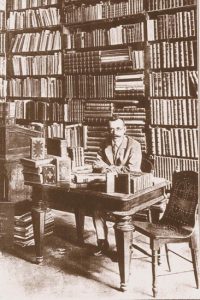
Mark Twain on Alcohol,
Cigars, and Writing Habits
By Daniel McAdam
I have a natural curiosity as to how other writers write. It's
not something easily observable, as most writing is done in private, so
when an author mentions his work habits, I end up either marveling at
the other writer's stamina or - less frequently - patting myself on the
back for being so productive. The excerpt that follows is from a
letter from Samuel Clemens, aka Mark Twain, in response to an inquiry
sent out to leading figures of the day regarding the use of stimulants,
such as alcohol and tobacco. The responses, and they were often
quite interesting, were then published in a book entitled, Study and
Stimulants, or, The Use of Intoxicants and Narcotics in Relation
to Intellectual Life, As Illustrated by Personal Communications on the
Subject, From Men of Letters and of Science. (Say what you
will, that's one heck of a subtitle!) The book was edited by A.
Arthur Reade, and dates from 1883:
I have not had a large experience in the matter
of alcoholic drinks. I find that about two glasses of champagne are
an admirable stimulant to the tongue, and is, perhaps, the happiest
inspiration for an after dinner speech which can be found; but, as
far as my experience goes, wine is a clog to the pen, not an
inspiration. I have never seen the time when I could write to my
satisfaction after drinking even one glass of wine. As regards
smoking, my testimony is of the opposite character. I am forty-six
years old, and I have smoked immoderately during thirty-eight years,
with the exception of a few intervals, which I will speak of
presently. During the first seven years of my life I had no health—I
may almost say that I lived on allopathic medicine, but since that
period I have hardly known what sickness is. My health has been
excellent, and remains so. As I have already said, I began to smoke
immoderately when I was eight years old; that is, I began with one
hundred cigars a month, and by the time I was twenty I had increased
my allowance to two hundred a month. Before I was thirty, I had
increased it to three hundred a month. I think I do not smoke more
than that now; I am quite sure I never smoke less. Once, when I was
fifteen, I ceased from smoking for three months, but I do not
remember whether the effect resulting was good or evil. I repeated
this experiment when I was twenty-two; again I do not remember what
the result was. I repeated the experiment once more, when I was
thirty-four, and ceased from smoking during a year and a half. My
health did not improve, because it was not possible to improve
health which was already perfect. As I never permitted myself to
regret this abstinence, I experienced no sort of inconvenience from
it. I wrote nothing but occasional magazine articles during this
time, and as I never wrote one except under strong impulse, I
observed no lapse of facility. But by and by I sat down with a
contract behind me to write a book of five or six hundred pages—the
book called “Roughing it”— and then I found myself most seriously
obstructed. I was three weeks writing six chapters. Then I gave up
the fight, resumed my three hundred cigars, burned the six chapters,
and wrote the book in three months, without any bother or
difficulty. I find cigar smoking to be the best of all inspirations
for the pen, and, in my particular case, no sort of detriment to the
health. During eight months of the year I am at home, and that
period is my holiday. In it I do nothing but very occasional
miscellaneous work; therefore, three hundred cigars a month is a
sufficient amount to keep my constitution on a firm basis. During
the family’s summer vacation, which we spend elsewhere, I work five
hours every day, and five days in every week, and allow no
interruption under any pretext. I allow myself the fullest possible
marvel of inspiration; consequently, I ordinarily smoke fifteen
cigars during my five hours’ labors, and if my interest reaches the
enthusiastic point, I smoke more. I smoke with all my might, and
allow no intervals.
MARK TWAIN.
March 14, 1882.
Before you run out and buy three hundred cigars, I'd caution you to
check with your doctor as to what effect this might have on your health.
Medical science has improved a bit in the last 125 years, and even back
then the perceptive Reade noted that, "if accurate statistics could be
obtained, it would be found that the value of life in inveterate smokers
is considerably below the average." Reade concluded his work
thusly:
I hope that young smokers will not conclude
that by following the example of Mark Twain, their brain will become
as fertile as his. To them tobacco is bad in any form. It poisons
their blood, stunts their growth, weakens the mind, and makes them
lazy. “It is not easy,” says Mr. Ruskin, “to estimate the
demoralizing effect of the cigar on the youth of Europe in enabling
them to pass their time happily in idleness.” It has been forbidden
at Annapolis, the Naval School, and at West Point, the Military
Academy of the United States, having been found injurious to the
health, discipline, and power of study of the students. “At Harvard
College,” says Dr. Dio Lewis, “no young man addicted to the use of
tobacco has graduated at the head of his class;” and at the lycees
of Douai, Saint Quentin, and Chambery it has been found that the
smokers are inferior to non-smokers. No public enquiry has yet been
made as to the influence of tobacco upon English youths, but I am
assured by several leading schoolmasters that the smokers are
invariably the worst scholars. It cannot be too widely known,
therefore, that tobacco, like alcohol, is of no advantage to a
healthy student, and I advise young men to avoid it altogether.
Darwin regretted that he had acquired the habit of snuff taking, and
Mr. Sala says that had he his life to live over again, he would
never touch tobacco in any shape or form. Never begun, never needed.
“I do not advise you, young man,” says Oliver Wendell Holmes, “to
consecrate the flower of your life to painting the bowl of a pipe,
for, let me assure you, the stain of a reverie-breeding narcotic may
strike deeper than you think. I have seen the green leaf of early
promise grown brown before its time under such nicotian regimen, and
thought the amber’d meerschaum was dearly bought at the cost of a
brain enfeebled and a will enslaved.”
My conclusions, then, are as follows:--
1.—Alcohol and tobacco are no value to a
healthy student.
2.—That the most vigorous thinkers and
hardest workers abstain from both stimulants.
3.—That those who have tried both moderation
and total abstinence find the latter the more healthful practice.
4.—That almost every brain-worker would be
the better for abstinence.
5.—That the most abstruse calculations may be
made, and the most laborious mental work performed, without
artificial stimulus.
6.—That all work done under the influence of
alcohol is unhealthy work.
7.—That the only pure brain stimulants are
external ones— fresh air, cold water; walking, riding, and other
out-door exercises.
|


|